Christ is Risen!
I hope you all had a very happy and blessed Triduum and Easter with your families and loved ones. Mine was truly wonderful. But before I get to that, I’d like to share with you some of my experiences over the last month.
On March 3, I participated in a Zoom meeting regarding the situation in Ukraine. 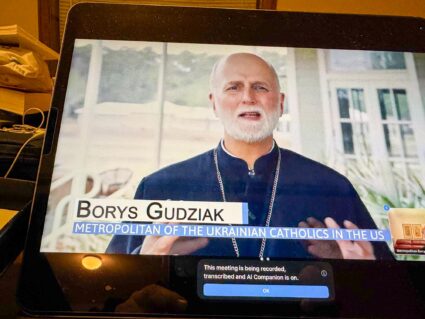
Archbishop Borys Gudziak, the Ukrainian Catholic Archbishop of Philadelphia, has started a campaign called the Healing of Wounds of the War in Ukraine Fund to help rebuild and provide humanitarian aid to the people there. I had suggested this to him at the time the war began. So, we gave him some help from Boston, and they’ve been very successful in raising money and trying to help people to be aware of the situation there.
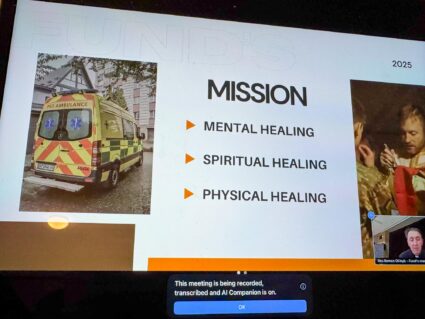
Archbishop Gudziak had a prayer service and meeting in which people from all over the country participated, and he asked me to lead a prayer and to make some remarks.
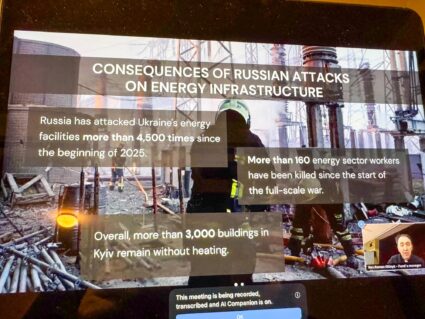
We’re still praying for the people of Ukraine and are grateful to those like Archbishop Gudziak, who has helped the people materially and pastorally and is doing so much to keep the needs of Ukraine before people’s minds here in the States.
On March 9, I traveled to Georgetown University for a Mass and conference on the role of women in the Church. It was organized by Kim Daniels, who is now the director of the Initiative on Catholic Social Thought and Public Life. She had this synodal gathering of Vatican and U.S. women leadership, and it was wonderful to see so many women there who I had been with for the two sessions of the Synod on Synodality.
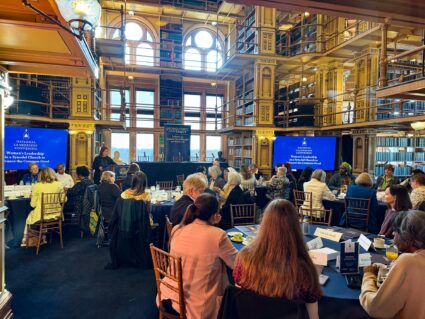
Among those present were Myriam Wijlens, a Dutch theologian who served with me on the Pontifical Commission for the Protection of Minors, and Sister Nathalie Becquart, a French nun who is the undersecretary of the General Secretariat of the Synod.
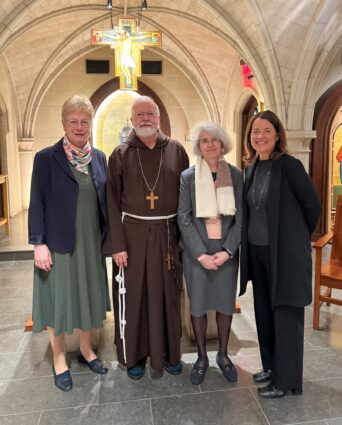
I had Mass for them in one of the little chapels there at Georgetown. 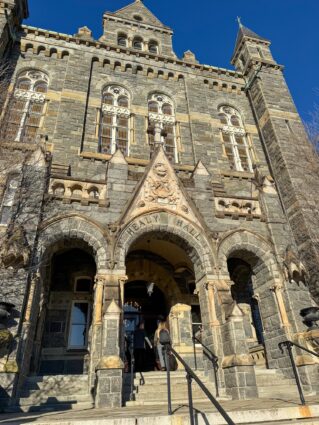
It was good to see them all again and to see that they are continuing to study synodality and see how it can be applied in the life of our Church.
On March 14, I was in Miami for the funeral of my first cousin, Deacon Rob O’Malley.
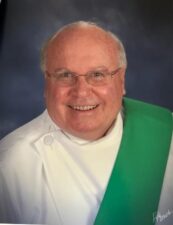 His father was a young lawyer in Miami when he died at about 40, leaving nine children. Rob was the oldest and became a kind of surrogate father to his younger brothers and sisters. Later on, he became a lawyer himself, but for the last 40 years had been a deacon at his parish, St. Richard’s, and had been teaching at Belén Jesuit Preparatory School in Miami. It was a very big funeral, with about 800 people. Of course, he had a very big family, but I think the numbers also reflected his many years of ministry in those two communities.
I reflected on Rob’s life in my homily and, afterwards, we heard some words of remembrance from Rob’s son.
It was a very nice funeral. And, of course, as you would expect from my family, we had the bagpipes and the singing of “Our Lady of Knock.”
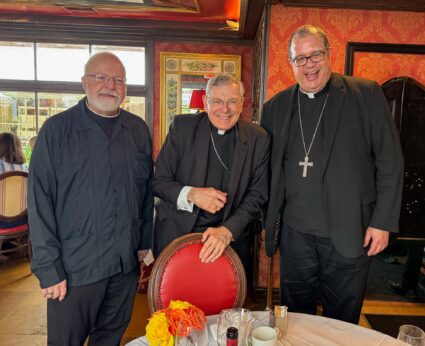
Because I was in Miami for the funeral, I joined Father Mario Castaneda, who had been my secretary when I was Bishop there, for lunch with the new Bishop of Palm Beach, Bishop Manuel de Jesús Rodríguez. We were also joined by Bishop Gerald Barbarito, who followed me in Palm Beach and served there for over 20 years. Bishop Manuel is originally from Santo Domingo but was a pastor in Brooklyn at St. Peter and Paul’s Church, where the former pastor, Mgsr. Augustin, was a very good friend of mine. I had been unable to attend his installation because I was giving a retreat at the time, so I was very glad to have the opportunity to meet him and talk to him, and Bishop Barbarito again.
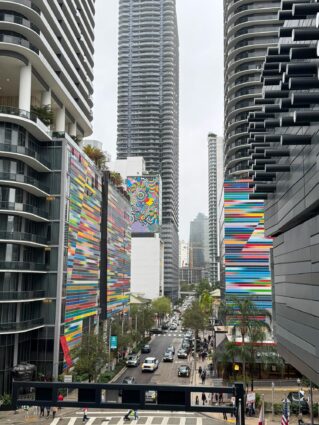
After lunch, I took a walk and passed by the Brickell City Center, which is this huge shopping center downtown. I had read in the paper that it was the most photographed street in Miami, but I wasn’t really sure where it was. Then, as I was walking along, I saw all these young people there with their phones taking pictures, and I said, “Oh, this is the street.” So I took a picture too, to be in on the craze!
On March 15, I participated in a Zoom meeting for the planning of the next New York Encounter.
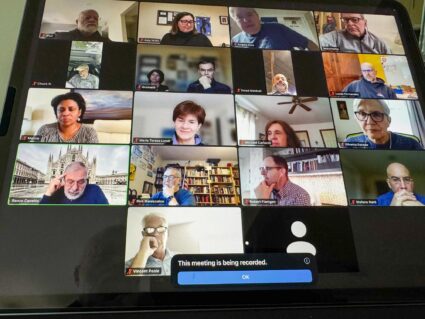
This event has become such a success, with about 30,000 young people participating this year. I am very grateful to Olivetta Danese and all of those involved in preparing the program. It’s so much work, but it is a wonderful means of evangelization and gathering young people where they can learn more about their faith and experience a sense of deep community with other young Catholics. So, I’m happy to be a part of their efforts.
Then, on March 22, I went to The Catholic University of America for the Gratus Dinner that they hold each year to thank the college’s benefactors.
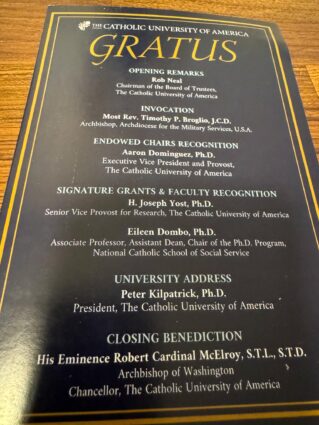
I was very honored by the recognition of the Cardinal Seán Patrick O’Malley Endowed Chair for the Study of Hispanic Catholics in America among the programs they highlighted.
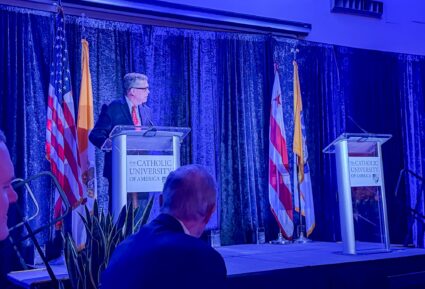
It’s one of a number of endowed chairs they are working on, which is a very good way for a university to be able to expand its reach, but also have the financial backing so that it can continue.
As I always do when I’m in Washington, I stayed at Capuchin College, where I was very happy to see Cardinal Fridolin Ambongo Besungu of Congo, who was with me on the C9 Council of Cardinals.
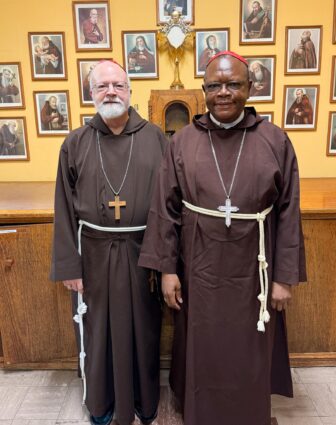
He was staying there for a month to study English. Also, at the same time, Bishop Donald Lippert was visiting from Papua New Guinea. So, actually, there were three Capuchin bishops at Capuchin College at the same time. I think that’s probably a record!
Father Emilio, Bishop Don and I also went to visit my old friends Tony and Manela Diez. Tony’s been sick, and I wanted to check in on them.
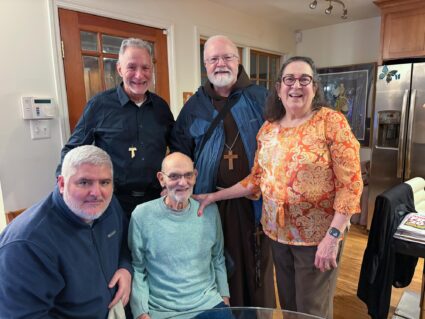
Manela worked with me years ago at Centro Católico, where she ran a number of the education programs. The biggest one was a program to train women to be bilingual secretaries. So, you could come to the Centro Católico, learn English, get a high school equivalency in Spanish, and then learn how to be a bilingual secretary to get a job somewhere like the World Bank or an embassy. It was a wonderful program, and she was such a big help to me.
She was also one of the people who helped type my doctoral dissertation. It was in five different languages, and she and two sisters helped me do it. (We had to rent extra typewriters.) I always say that those of us who got our PhDs in the past should have a star by our names, meaning we had to do it with no word processors or computers. Every page would have to be typed two or three times because you’d make a mistake; you’d have to retype the page, and when you did, you would probably make a second mistake. And it just went on and on! So, if it hadn’t been for Manela and the sisters, I would never have gotten that dissertation finished in those days.
When it came time to graduate, they asked me when the ceremony was. I said, “Oh, I’m not going to the ceremony.” And they said, “You certainly are going to that ceremony!” They would have killed me if I hadn’t gone; they worked so hard on that.
On March 28, I attended the Faith and Veritas conference at Harvard University, at which Mary Ann Glendon was honored with the establishment of a Harvard Law School fellowship in her name, the Mary Ann Glendon Fellowship Program in Law, Life, & Liberty.
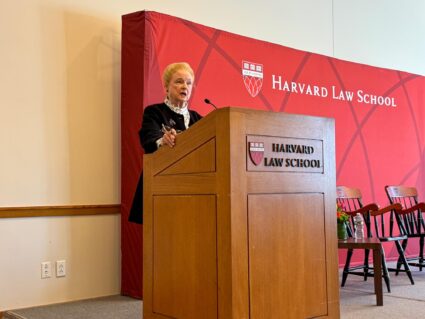
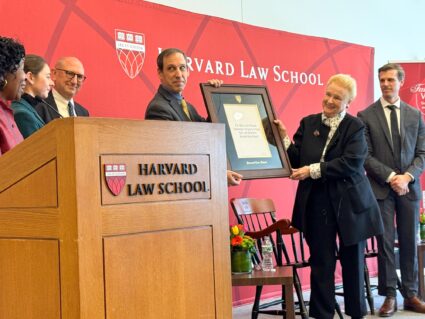
She gave an extraordinary talk, and I was asked to offer some remarks as well, which I’d like to share with you here:
At some formal affair, perhaps at Oxford, an Anglican divine was introducing Sir Winston Churchill and referred to him as “a pillar of the church.” Churchill corrected him, saying, “I am not a pillar of the church, I am more like a flying buttress.” In Psalm 144, we read, “that our sons may be as plants grown up in their youth, that our daughters may be pillars, carved columns beautiful as those of the temple.” Mary Ann Glendon is a strong pillar and beautiful column in the Lord’s Temple.
It is a great joy to be here with all of you today at this Faith and Veritas conference here at Harvard University and to express our delight that you have decided to honor Ambassador Mary Ann Glendon for her outstanding contributions to our country, to our church, and to our community. This university is one of the most prestigious universities in the world and has been a force for the good in so many areas of life. It is not surprising that Harvard would recognize the genius of Mary Ann Glendon and her contributions.
My friendship with Mary Ann Glendon goes back 35 years, when I first came to Massachusetts as Bishop of Fall River. I have always known her to be a woman of deep faith committed to the values of the gospel. Her unwavering commitment to the defense of the dignity of human life, made in the image and likeness of God, and her eloquent promotion of human rights, especially freedom of religion and conscience, have been inspirational.
This ancient institution of Harvard, in its history, has had three mottos: “In Christi Gloriam”, “Christo et Ecclesiae”, and, more recently, “Veritas.” All three of these stirring ideals find an echo in Mary Ann Glendon’s personal life as well as in her professional and academic life. Her path has always been what Anselm of Canterbury describes in his concept of “Fides querens intellectum.” There is no contradiction between faith and reason; both illumine the path to truth, to Veritas.
Reason left to its own devices eventually abandons the search for great truth, and that diminishes our humanity, and we lose direction. As Pope Francis said: “There is an urgent need then, to see once again that the faith is a light, for once the flame of faith dies out, all other lights begin to dim.” Thanks to faith, we have come to understand the unique dignity of each person. Without the insight of faith into the realities of God’s embracing all humanity, there is no criterion for discerning what makes human life precious and unique. Man loses his place in the universe; he is cast adrift in nature, either renouncing his proper moral responsibility or else presuming to be a sort of absolute judge, endowed with an unlimited power to manipulate the world around him. (Lumen Fidei 54)
The Second Vatican Council defines the role of the laity as a call to sanctify the secular order, politics, culture, economy, and the family. Gaudium et Spes, the Council’s pastoral Constitution on the Church in the Modern World, sees the church’s mission as engaging with, serving, and understanding the world’s joys, hopes, and anxieties. It emphasizes promoting human dignity, the common good, and dialogue with contemporary culture. Today, we are honoring a woman who is the incarnation of those ideals of a modern Catholic leader. We have all been the beneficiaries of her talent, generosity and goodness, and we relish this opportunity publicly to manifest thanks to God for the gift of this great lay woman in our midst.
In a recent book, talking about the crucial role of the laity, Mary Ann quotes two great modern prophets in the church: St. John Henry Newman and the soon-to-be-Blessed Fulton Sheen. St. John Henry Newman, in response to the bishop who asked what he thought of the laity, said: “We looked pretty foolish without them”. And when Fulton Sheen was asked, “Who is going to save the church?” He replied: “Not our bishops, not our priests and religious! It is up to you, the lay people! You have the minds, the eyes, the ears to save the church!” Mary Ann Glendon’s service to the church as a dedicated lay woman has been a great blessing. Pope Paul VI said that more than teachers, we need witnesses.
Mary Ann Glendon’s vocation has been both to be a teacher and to be a witness. I have known so many of her students who have expressed their gratitude for having had such a guide, not just in their academic life but in their spiritual life. She is a great teacher who inspires with her brilliant intellect but also with her vision and courageous defense of the truth. Mary Ann Glendon has never been a person to teach one thing and do another. Her coherent life of fidelity and service reinforces the message that she expresses so eloquently in academia and in the public square. Her capacity to articulate the ideals of the gospel for modern people has touched the hearts and minds of many who may never have had the opportunity to glimpse the truth that her intellectual prowess, personal virtue and eloquent arguments communicated to them.
Mary Ann, your life has been marked by the unfailing devotion and love of Ed Lev and your beautiful daughters, as well as the affection and gratitude of your many students and coworkers, the admiration of countless people all over the world, and the confidence deposited in you by presidents of the United States as well as popes of the Catholic Church who have called upon you for great responsibilities. I am proud to be counted among those who recommended that you be named an ambassador. For a while, Boston had a lock on Vatican ambassadorships with three stars: Ray Flynn, Ken Hackett and Mary Ann Glendon. But for full disclosure, I should tell you, I also recommended that they name you a Supreme Court Justice. I’m still waiting on that one.
While in Cambridge, I passed this statue of Charles Sumner. I must have gone by it a million times in Cambridge, and I never knew that was him.
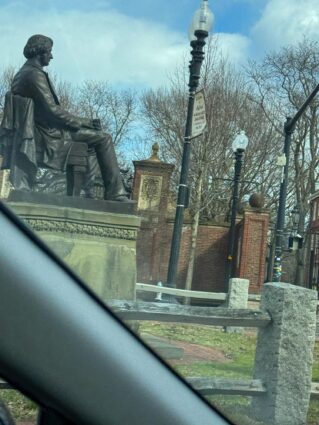
There was a wonderful book about him that came out last year, “Charles Sumner: The Conscience of a Nation” by Zaakir Tameez, and I was so impressed with his life. To me, he was one of the great Bostonians. He was a huge promoter of human rights, a sworn enemy of slavery, and one of Abraham Lincoln’s closest advisers. In fact, he was with Lincoln when he died. And he himself, when he was a senator, was almost beaten to death by a Southern senator with a cane because of his speeches against slavery.
The interesting thing about him is that his father was a graduate of Harvard but had all kinds of economic problems, and so the family lived in a poor section of Beacon Hill that was predominantly Black. So, his opinions about slavery and about Black people were shaped by the fact that he grew up in a Black community and knew how capable they were. Many of the people who opposed slavery thought the solution was to send the Black population back to Africa from whence they had been kidnapped, but he saw how these Black Americans could make a great contribution and really were a valuable part of the community.
So, he was very forward-looking. So much so that, later, when they finally desegregated the schools, the judges went back and were using arguments that he had used when he was trying to get them to allow Black students into public schools in Boston at the time of the Civil War. It’s a very interesting story, so when I saw that statue, I was very struck by it.
On March 30, I celebrated the funeral Mass for Ann Carter at St. Paul Parish in Wellesley. Sadly, she declined very quickly from a very aggressive cancer. It was only a few weeks ago that she came to visit me at the cathedral, and she would always make homemade pasta for us.
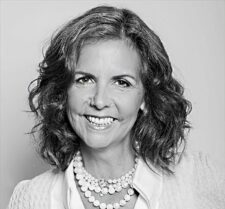
Ann was a great woman, and I had recommended her to Pope Francis for the Dicastery for Communications in Rome. Both she and Kim Daniels were two American members of the Dicastery and both of them are extremely competent, committed, wonderful Catholic laywomen who have been invaluable to the Church with the advice and help they have given. Kim actually wrote a beautiful article for Vatican News about Ann, which I quoted in my comments at the funeral and that I’d like to share with you here:
The overwhelming sentiments that pulsate in our hearts this morning are those of gratitude for the life and goodness of our friend Ann Carter and the sorrow that crushes our hearts like a stone as we contemplate her departure. Our faith gives us the consolation that life is not ended but merely changed. As believers, we know that our life is a round-trip ticket: our origins are in God, and we return to him as our destiny and destination.
During this Lenten season, we have a beautiful devotion which we call the Stations of the Cross. In one of the stations, Jesus stops to console the women of Jerusalem who are weeping because of his suffering. Although Jesus was enduring such excruciating pain and humiliation, he was not thinking about himself but sought to console those holy women who are overwhelmed by the sight of his pain. This Lent has been Ann Carter’s Stations of the Cross, but like Jesus, she was focused not on her own suffering but on her desire to mitigate the suffering of her loved ones.
For many years, as a young friar, my day began at 4:45 a.m., chanting the Litany of the Saints in Latin. One of the petitions of that litany is: “A subitanea et improvisa morte, libera me, Domine.” (“From a sudden and un-provided death, Lord deliver us.” At the time, it seemed to me to be counterintuitive. We all seem to want to die in our sleep, dying painlessly and quickly. Anne’s was not a sudden death, and certainly not an un-provided death. She died surrounded by love, all the while communicating her love and strength to her family and friends. If any could speak to us here today, she would tell us not to weep, that love is stronger than death.
When a meteor comes crashing to earth, it leaves a huge footprint. Ann was a star who made a huge impression on our community. It was always a delight to be with Ann. She radiated energy, light and joy. She had a genuine interest in people and their well-being. In a world where common sense is the least common of the senses, Ann was a woman of great intellectual capacity, good humor, true wisdom and unwavering common sense. It has often been said that we will remember people not because of what they say or what they do, but how they make us feel. In the case of Ann, I’m sure that we shall remember her sayings and her deeds, but especially how good she made us feel.
In today’s world, there is a crisis of suspicion. People do not trust that they are being told the truth by politicians, business executives, doctors, the clergy or the media. We are literally drowning in information, but we don’t know what to believe. Certainly, people demand that others tell them the truth, even when they’re not convinced they have the same obligations themselves. Ann Carter brought to her professional life honesty and sincerity that allowed reasonable people to overcome their suspicion and cynicism.
I want to quote here from Kim Daniels, who wrote this for the Vatican news: “Ann exemplified credibility and fostered trust, which she knew was born, in Pope Francis’s words, not from marketing or strategizing but from the beating heart of the Gospel. Her counsel was rooted in the conviction that good communication begins with substance, not spin and that substance grows from truly listening to others. She articulated this as a professional principle, but it was first a personal one. She listened to people with patience and attentiveness that made everyone around her feel genuinely heard.”
As soon as I heard about Ann’s passing, I informed Pope Leo of her death and of the extraordinary service that she gave to the Church of Boston and to the Vatican during the pontificate of Pope Francis. The Holy Father assured me of his prayers for Ann and for all of us here today who mourn her passing. May our beloved friend celebrate this Easter in the realms of eternal light and joy with our Risen Lord.
We also want to remember Bishop Bill Murphy, who passed away at the end of March. As many people know, he was an auxiliary here for a long time before becoming Bishop of Rockville Centre on Long Island. He retired in 2016, and for about the past year, he had been living with us at Regina Cleri.
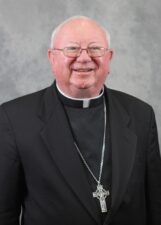
His funeral was this week, and I felt badly that I wasn’t able to get to New York for it, but we want to express our condolences to the people of the Diocese of Rockville Centre, Bishop John Barres and his friends and family. We also want to express our gratitude for the staff at Regina Cleri, who always take such good care of our priests.
Finally, of course, last week was Holy Week, and I was happy to be able to join the celebrations with people here in Boston.
On Tuesday, of course, we had the annual Chrism Mass, and it was wonderful to see everybody.
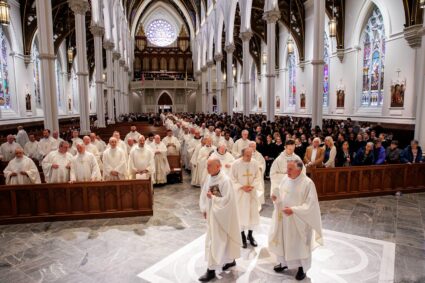
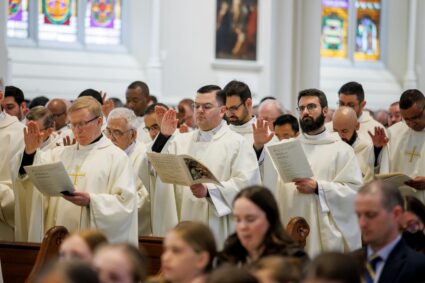
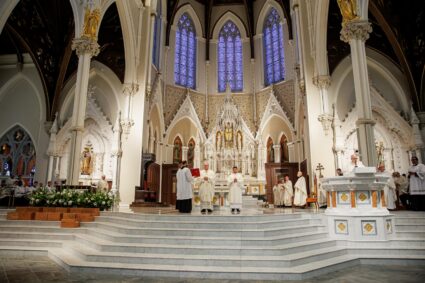
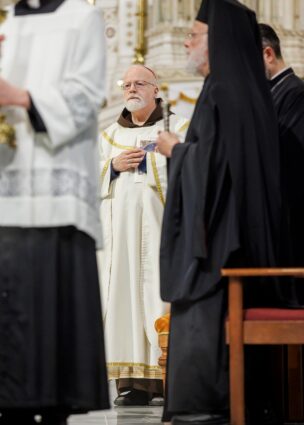
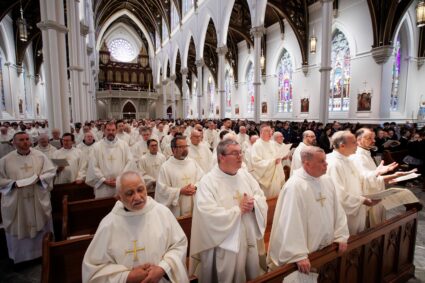
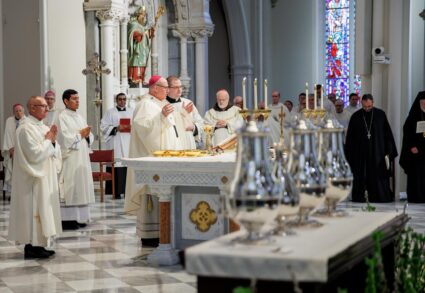
On Holy Thursday, I had the Mass at St. Mary’s in Brookline. Then, on Friday, we had the procession here at the cathedral, and I had the English services in the afternoon and the Spanish services in the evening.
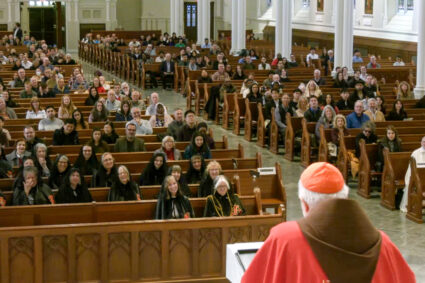
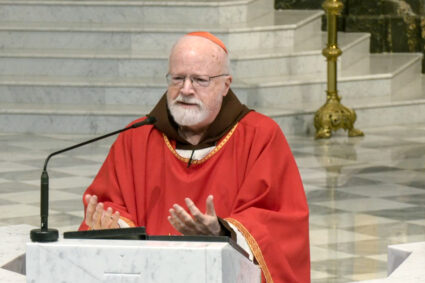
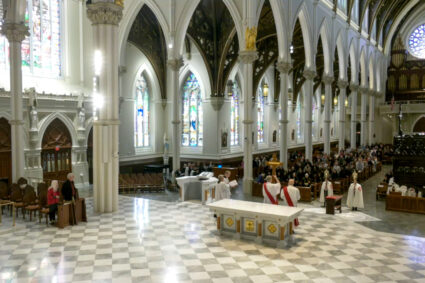
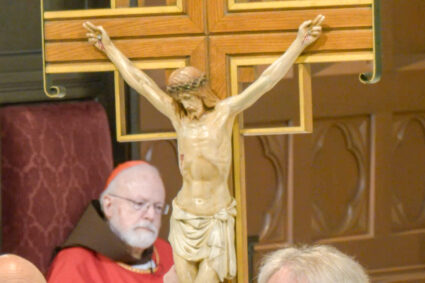
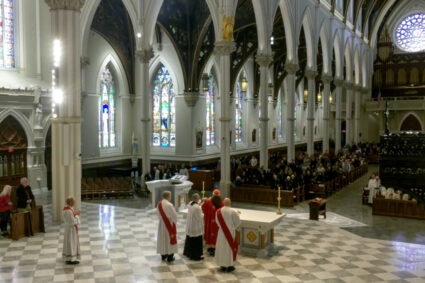
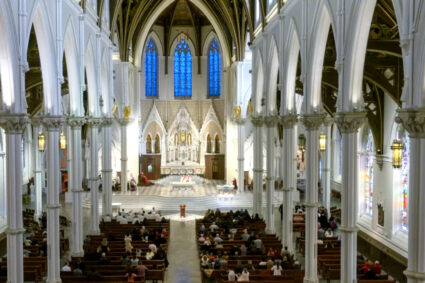
Saturday, I concelebrated the Easter Vigil with Bishop Robert Reed at the cathedral.
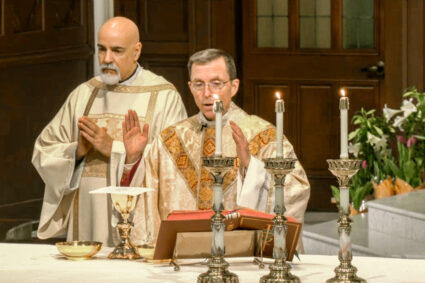
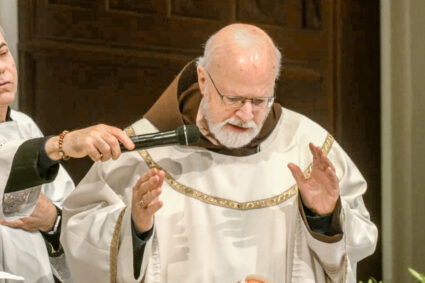
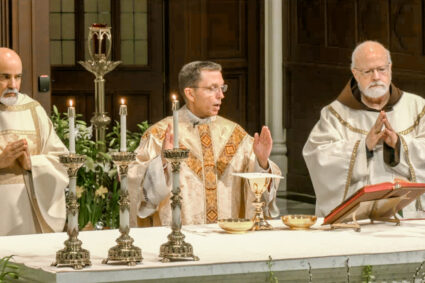
He has a great voice, and he sings absolutely everything. It’s amazing! He puts every priest to shame! I was amazed. We know that he will bring that beautiful way of presenting the liturgy to his new role as rector of St. John’s Seminary as he trains future priests.
On Easter Sunday, I had the Spanish Mass, and the cathedral was packed. It was very encouraging.
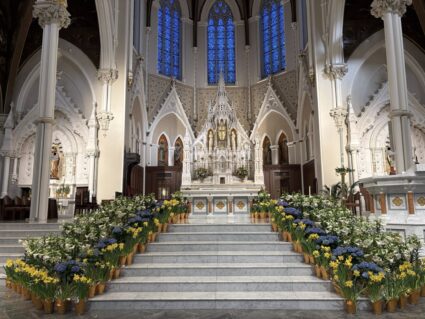
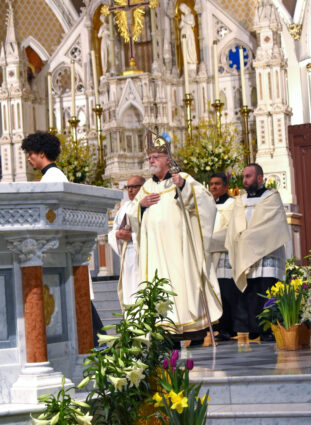
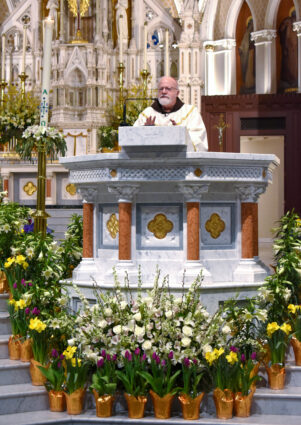
Everybody’s talking about how this Holy Week, numbers are up, and many more people are coming into the Church, which brought to mind this picture I received from Father Maurus in Washington of the Capuchin Church in Zagreb during Holy Week.
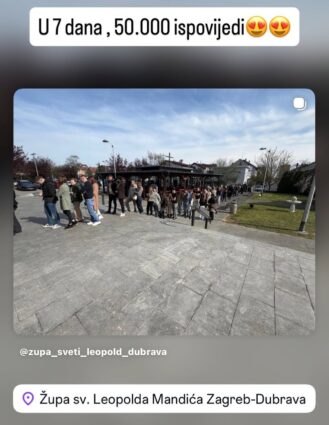
They had 50,000 confessions, and you can see the people lined up down the street. I know a lot of our churches where we have many confessions, but 50,000 in one week is a lot by any standard!
Until next time,
Cardinal Seán