Hello and welcome!
Earlier this month, I had the pleasure of meeting at the cathedral with Thaddeus Kennedy, a young law student at Harvard who was referred by Professor Mary Ann Glendon. 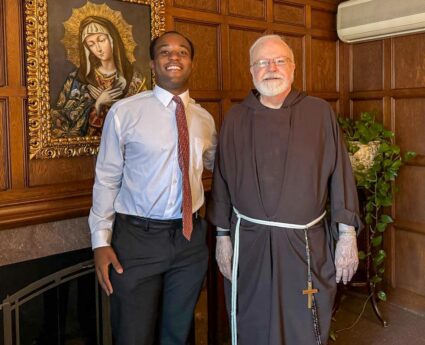
Thaddeus is very involved with the Harvard Catholic community, and it is so encouraging to see these young professionals becoming involved in the life of the Church.
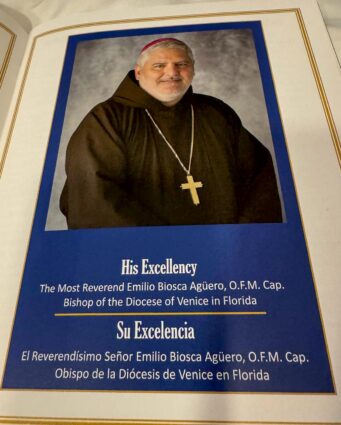
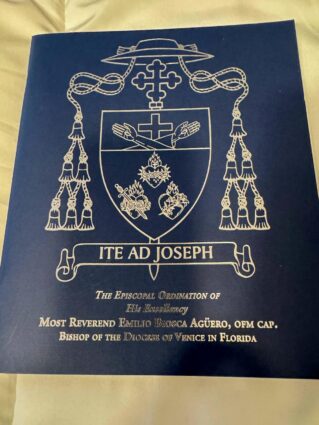
On July 11, I attended the episcopal ordination of Bishop Emilio Biosca, who was named the third bishop of Venice, Florida.
I have known his family for over 50 years. His father and mother came from Cuba after the revolution. His father is a dentist, and he was a member of the Agrupación Católica, and he helped me start the dental clinic in the Centro Católico in Washington. It was in those years that, of course, I came to know young Emilio.
When we started the house for discernment, the Casa Galilea, he came and lived with us there and indeed discovered his vocation to be a Capuchin friar. I always say it was a wonderful experience, and while we didn’t have the Casa very long, there were wonderful vocations that came out of it — a number of priests, five bishops and two cardinals. Emilio is the last one of the bishops to be named from the “Galileos,” as I called them.
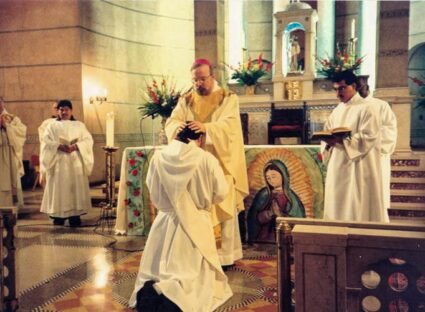
After he was ordained, he was a missionary in Papua New Guinea for 10 years. Then he went and worked for 10 years in Cuba, where he was a pastor in Manzanillo. Afterwards, he returned to take charge of Sacred Heart Church in Washington, which is the largest parish in Washington, with four Spanish Masses, a Haitian Creole Mass, a Portuguese Mass, a Vietnamese Mass, and an English Mass. He did extraordinary work there, particularly of late with the immigration crisis.
So we were all unsurprised to see that he was named a bishop because of his great talent, hard work, and personal holiness. But we were surprised that it was to Venice, Florida rather than some mission territory! I am sure that he will do a wonderful job there, and the reception from Bishop Frank Dewane and the people of Venice has been so positive and enthusiastic.
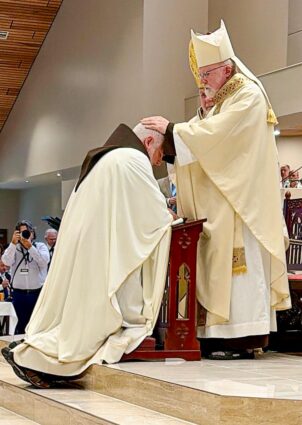
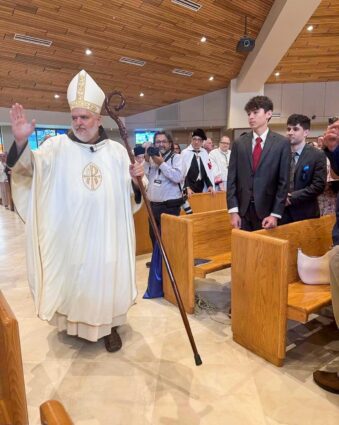
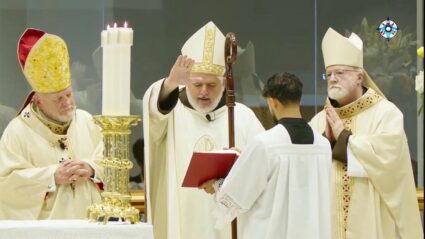
The ordination was held at St. John XXIII Church in Fort Myers because they are currently building a new cathedral.
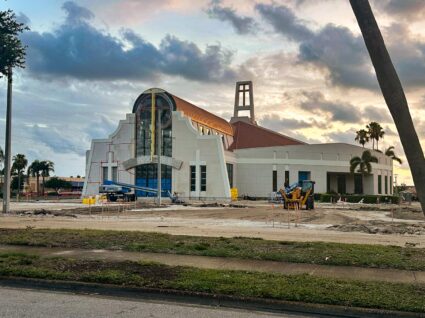
It is a beautiful, huge church that held a very large crowd—I think, with the rooms connected to the church, there were probably 2,000 people there. It was a beautiful celebration. I was so pleased that so many members of the Biosca family were able to be there; his mom and dad were there.
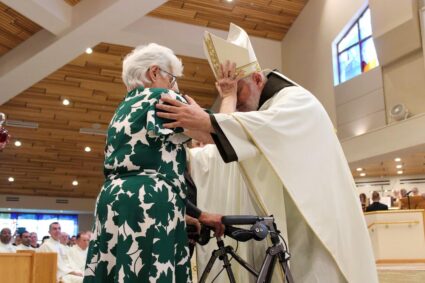
He also has a sister who is a Colettine Poor Clare in Roswell, New Mexico, who, of course, could not be there in person, but I am sure was watching on the livestream. It was a very emotional and beautiful celebration.
From July 13 to 15, I participated in the Orientale Lumen Conference, an annual gathering of Orthodox, Eastern Rite Catholics, and Roman Catholics held at the retreat house for the St. John Paul II National Shrine in Washington. This conference has been organized for 30 years by Jack Figel, who is himself an Eastern Rite Catholic. This event brings together bishops, clergy, and laity to look at ways to build communion through theological dialogue, shared fellowship, and joint prayer.
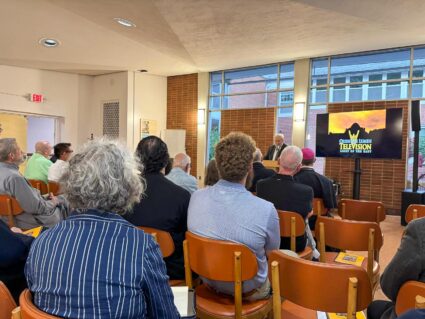
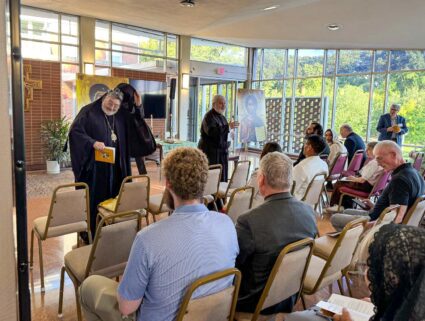
The Apostolic Nuncio was present, as was Archbishop Flavio Pace, secretary of the Vatican’s Dicastery for Promoting Christian Unity, who flew in from Rome. Bishop John Michael Botean, a Romanian Catholic bishop, also gave one of the talks. Bishop John Michael had studied at our Capuchin seminary, so I was very happy to be reunited with him there.
While I was in Washington, I also had the chance to see Montse Alvarado, who came by to say hello.
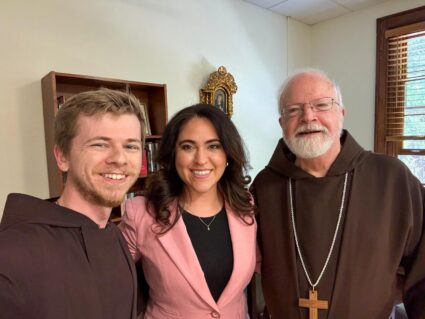
I have known her for a long time, and she has been a parishioner at Sacred Heart, our Capuchin parish in Washington.
On July 17, I had an interview via Zoom with Catherine Hadro of EWTN regarding our relief efforts for Cuba.
That was just as I was preparing for a meeting of about 35 individuals representing various groups working to bring relief to Cuba and working directly with Caritas Cubana for the distribution of aid to the people. Micho Spring, Consuelo Isaacson, and Felice Gorordo have worked very closely with me on this initiative.
We had representatives from the Order of Malta, the Friends of Caritas Cubana, Catholic Relief Services (CRS), and other organizations that have been involved in Cuba, including some from the private sector.
I had organized the gathering to be held at the U.S. Conference of Catholic Bishops, but due to travel disruptions (I was stuck for 12 hours at the airport the day before when all flights were canceled!) a number of us were unable to travel to Washington in person. So, myself and about 10 to 15 other participants ended up joining the two dozen or so people in the room via Zoom.
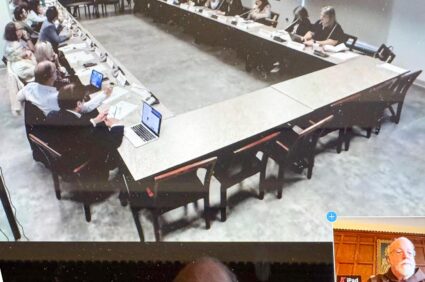
The U.S. government recently provided a grant of $100 million for relief, with $60 million assigned to CRS and Caritas Cubana for distribution. Even though that sounds like a lot of money, for an entire country experiencing severe shortages of food, water, electricity, and medicine, it is just a start at alleviating a national crisis. In our meeting, we discussed ways to effectively carry out this work because the needs are so great.
Each diocese in Cuba has a center of Caritas that will be working on distribution; they have been constantly involved in bringing food, particularly for children and the elderly. However, without reliable energy sources, refrigeration and preserving food is very difficult, and there is no milk for the children, for instance. Food spoils quickly in the hot climate, and distribution becomes immensely difficult when you lack fuel for the delivery trucks. These were the critical issues we discussed in our meeting, and we hope to come up with joint recommendations and requests for both governments involved.
On July 25, I traveled to Pittsburgh to attend the funeral for Father Bill Graham, held at St. Augustine’s, our provincial house.
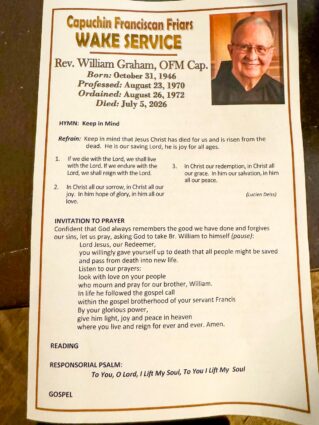
Father Bill was a friar of my province who was a skilled canon lawyer and who helped us for a while in Boston working in our Metropolitan Tribunal. He then went on to work for many years at the tribunal in Baltimore. He had been ailing for several years before he passed away.
He was a beloved friar whose ministry touched the lives of many people, and he will be sorely missed. I was very glad I was able to be present for his funeral Mass.
The following day, July 26, I visited Our Lady of Mount Carmel Parish in New Bedford for the 30th anniversary of the parish feast day celebration. The parish feast was originally started 30 years ago when Father Henrique Arruda was the pastor, and Father Arruda was present concelebrating the Mass alongside the current pastor, Father Christopher Peschel. They held a big procession and a beautiful Portuguese Mass that was livestreamed.
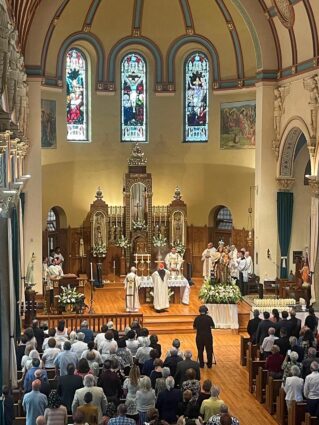
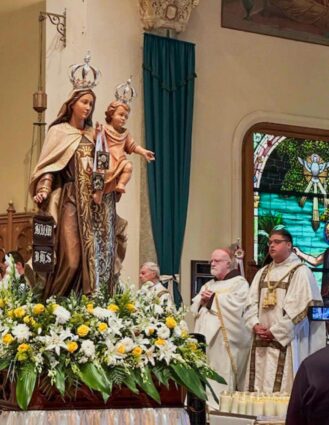
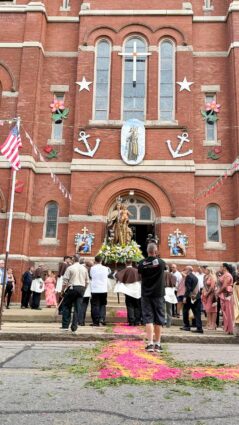
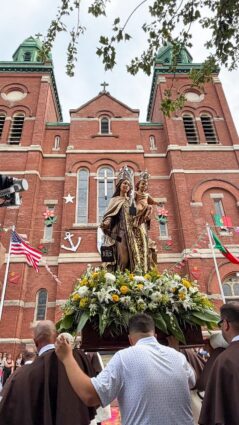
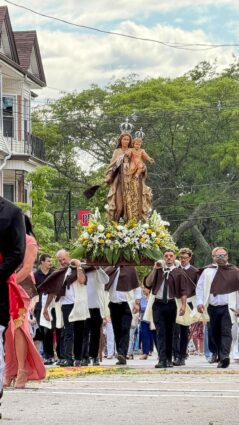
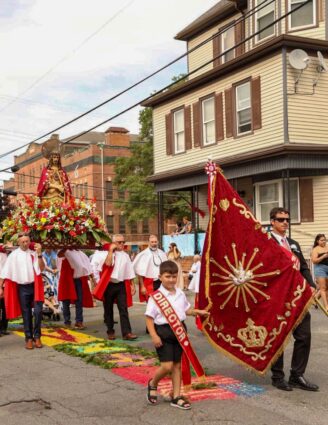
I had not been to Our Lady of Mount Carmel for many years. When I was Bishop of Fall River, it was a very vibrant Portuguese parish and the largest parish in the diocese. Father Peschel is doing a great job there as pastor, and it was wonderful to see so many people once again after so many years.
It turned out to be something of a “Fall River week” for me, because on July 28, I was also with the Dominican Sisters of the Presentation in Dighton.
The Dominican Sisters of the Presentation were the congregation that ran St. Anne’s Hospital in Fall River. It is a French foundation, but they have a very large presence in Colombia. When I was working in Washington as a young priest, I had a number of the Colombian sisters from that congregation working with me. At one point back then, I traveled up to Dighton to give a retreat for them. It was actually the only time I had been in the Diocese of Fall River prior to being named bishop there. Afterwards, of course, I came to know the sisters well during my time in Fall River, and I dedicated the chapel where we held our Mass.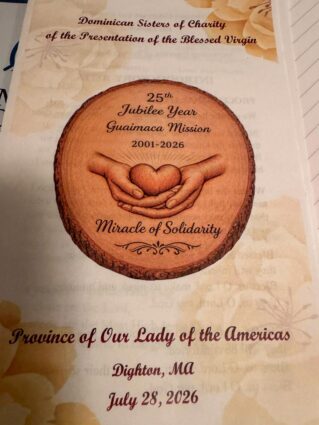
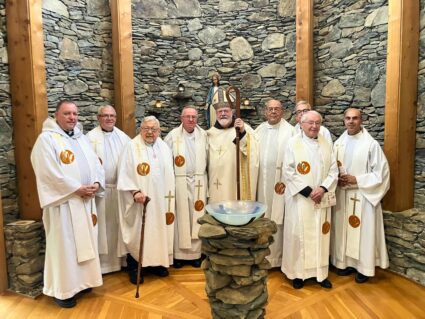
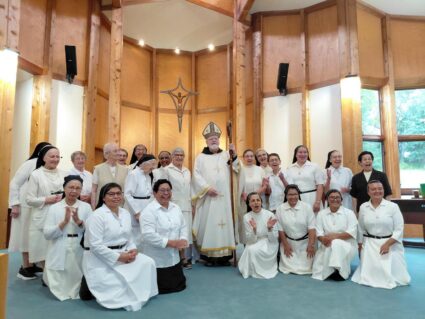
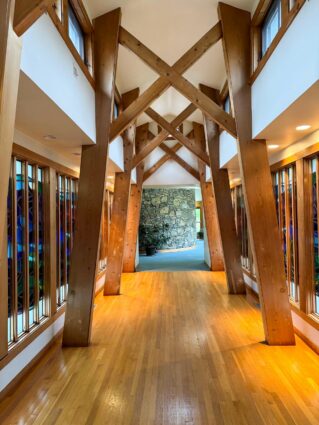
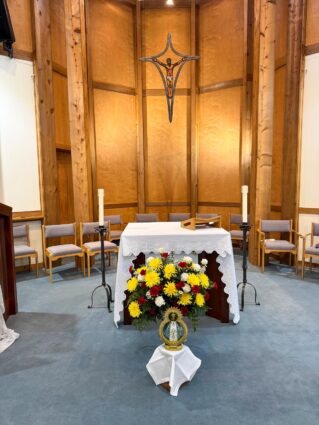
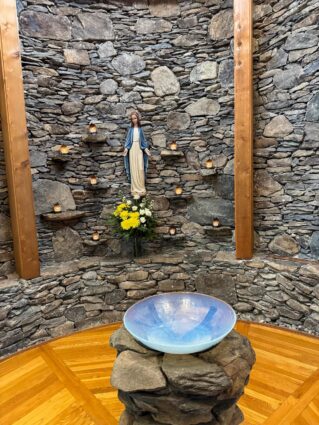
The sisters invited me to celebrate the 25th anniversary of the establishment of their mission at Guaimaca in Honduras. That mission grew out of an initiative I organized when I was Bishop of Fall River for the Jubilee Year 2000. I was discussing with our pastoral council what we should do for the Jubilee Year, and I was very anxious for us to do something missionary, and we decided on trying to sponsor a parish.
So I went down to Tegucigalpa, and the cardinal sent me into the countryside looking at these parishes, and he said I could choose whatever one I wanted. And this parish at Guaimaca was huge and had not had a resident priest for many years. There was only a priest who was going there on the weekends from the seminary, and here you had this huge church and something like 30 or 40 chapels.
When the priest would go, he lived in the sacristy of the church. And then while he was in his last period there, he built a rectory. But the rectory was huge. And so I told everyone, “This is the kind of rectory you build when you’ve lived in the sacristy for 20 years!”
So we sent down a team consisting of two priests, a deacon and his wife and two Dominican sisters, and the rectory was big enough to put the whole team there except the sisters. The sisters lived in the attic of the church.
The sisters eventually established an official mission of their congregation there, opening a school for girls, a clinic, and a center of evangelization. One of those original sisters, Sister Maria, was present for the anniversary along with Father Paul Canuel, one of the original priests.
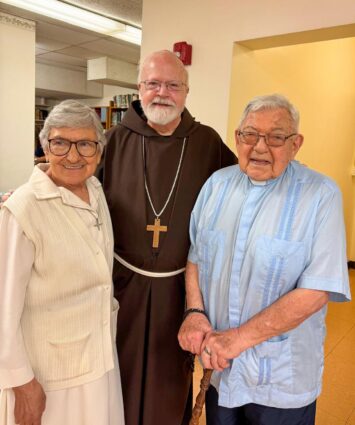
It was a very joyful celebration, and I was so thankful that the sisters have been able to do such extraordinary work and continue their commitment to that rural area of Honduras.
On July 30, I traveled to Denver in advance of the Knights of Columbus Supreme Convention.
While in Denver, I stayed with our friars at St. Francis Friary and celebrated Mass at Annunciation Parish, a Mexican parish served by our friars.
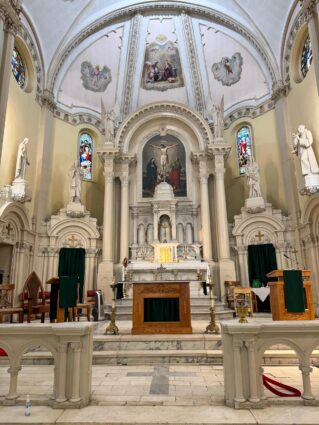
It was wonderful to celebrate Mass there on the Feast of the Portiuncula, which also marked my 42nd anniversary of episcopal ordination.
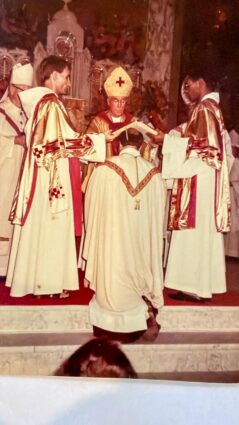
I have a lot of family in the Denver area, so it was a great joy to celebrate that milestone surrounded by many of my relatives before heading into the activities for the Knights of Columbus convention, which I’ll tell you all about in my next post.
Until then,
Cardinal Seán